
EDITORIAL FACT CHECK · UPDATED 11 NOVEMBER 2026This page checks public claims about the recent 72-hour preparedness coverage. It is not a live warning, and it does not predict what will happen next.
Posts claiming that many governments are acting together because they know an imminent event is coming have spread alongside emergency-supply advice. Some versions describe a planned worldwide blackout on 17 November 2026. The real announcements are worth understanding, but the public evidence does not support those conclusions.
What is actually happening?
There is a genuine rise in public preparedness messaging, but the items grouped into viral lists are not all new or the same kind of advice. The European Commission’s 72-hour principle appeared in its Preparedness Union Strategy on 26 March 2025; on 3 November 2026 it presented non-binding population-preparedness guidelines. The UK launched its “Be Ready” campaign on 22 October 2026, while saying household resilience advice had existed since May 2024 and much of it was unchanged. Japan issued a nationwide disaster-preparedness request on 2 November 2026, focused on earthquake and volcanic hazards. The UK government says it learned from other countries’ campaigns, so policy-sharing is documented; that is different from evidence of a secret, synchronized warning.
Official rationales include earthquakes, volcanoes, storms, floods, wildfires, power or water disruption, cyber and hybrid threats, and making sure households can manage while emergency services mobilise. The balance differs by place. The EU’s 2025 strategy explicitly discusses geopolitical conflict as one risk among several; its existence does not establish that a particular war is imminent.
Claim: “Thirty-three countries issued one coordinated warning”
Finding: the number comes from a media compilation, not a joint government order. Newsweek’s map, published 28 October 2026, gathered countries and places with some kind of emergency-supply advice. It combines different source dates, risks, supply periods and geographic scopes. Some recommendations are longstanding; others are recent campaigns or updates. A map count is not evidence that all listed governments acted together, used the same threat assessment, or announced an emergency on the same day.
For each entry, check the original issuing authority, the date on the actual advice, the date of any update, and whether the item is a national policy, local recommendation, campaign, or media summary. Our dated November briefing compares the recent examples and their older origins.
Claim: “A global blackout is planned for 17 November”
Finding: no credible evidence supports a planned worldwide power or internet shutdown on that date. There is a real US event that some posts attach to the rumor: the Federal Communications Commission announced on 16 September that FEMA would conduct a nationwide Emergency Alert System test on 17 November at 2:20 p.m. Eastern Time. Its published test message says it is only a test and no public action is required. It is a communications-system test for the United States, not a power-grid shutdown or a worldwide event.
Recent reporting has also traced the rumor to unrelated material being combined online, including a television-cartoon scene and emergency-kit guidance. A coincidence of dates or a test message does not establish a blackout plan. If the scheduled test changes, follow FEMA and FCC notices.
Claim: “Japan’s new agency or checklist means officials know when a megaquake will strike”
Finding: the 2 November request names serious natural hazards but gives no predicted date. The new agency is intended to strengthen disaster coordination and response. Associated Press reported that it was not created in anticipation of one specific calamity and that experts cannot predict the specific timing and location of major earthquakes. The request asks people to prepare because the consequences could be severe, not because a date has been forecast.
Claim: “Thailand’s government ordered stockpiling because of the Middle East conflict”
Finding: this mixes a false alert story with separate general disaster advice. On 30 October 2026 Thailand’s government portal relayed the National Security Council’s denial that it had issued a 72-hour stockpiling alert linked to the Middle East. A separate government department later summarized DDPM-attributed emergency-bag advice for general hazards. On 9 November the Prime Minister’s Office said not to panic-buy, reported no national shortage signal and described the bag as general preparedness, not a sign of war or a supply crisis.
Why do several governments use a three-day target?
Three days is a practical planning window for the first phase of a disruption: roads, utilities or communications may be interrupted, responders may be dealing with many households at once, and public assistance can take time to reach everyone. The EU’s own wording frames the first 72 hours as a period while assistance is being mobilised. The number is a preparedness target; it is not a countdown and does not promise services will resume after three days.
The timing of current headlines also has a simple media explanation: a set of new campaigns and one recently dated Japanese appeal were collected into a map, after which social posts combined them with older advice and unrelated claims. That explains how the story became prominent; it is an inference about coverage, not proof of what every government privately considered.
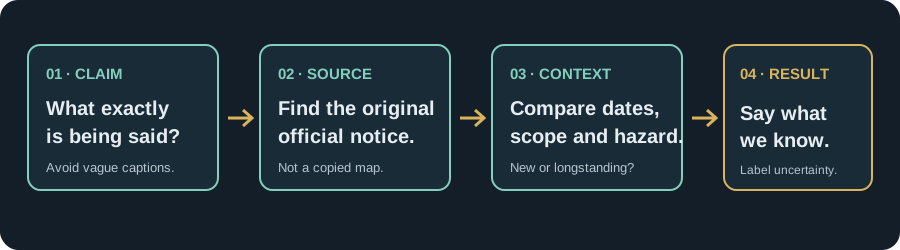
How to assess the next claim
- Find the original government notice rather than relying on a screenshot, map or copied list.
- Check issue date, update date, geographic area, hazard, and whether the wording is advice, a formal alert, a law, or a campaign.
- For predictions, look for an accountable issuing authority, a stated method and independent confirmation. A preparedness leaflet alone is not a forecast.
- For the 17 November US test, use the FCC public notice and FEMA’s bulletin. Follow local authorities for real emergencies.
- Prepare sensibly for local hazards without panic-buying. Use the country directory and the official links on each profile.
Join the member discussion and live chat ↗ (free registration required).
Join the member discussion and live chat ↗ (free registration required).
Join the member discussion and live chat ↗ (free registration required).
Sources and dates
- European Commission: new guidelines — published 3 November 2026; says the guidelines are non-binding and builds on the March 2025 strategy.
- European Commission: Preparedness Union Strategy — 26 March 2025; lists geopolitical, hybrid/cyber, climate and natural-hazard risks.
- UK Cabinet Office: Be Ready launch — 22 October 2026; states household advice has existed since May 2024 and much remains unchanged.
- Japan Disaster Management Agency: nationwide preparedness request — issued 2 November 2026.
- Associated Press: Japan’s new disaster-management agency — 2 November 2026; reports the stated natural-hazard rationale and no specific predicted calamity.
- Thailand government portal: NSC denial — 30 October 2026.
- Thailand Prime Minister’s Office: supply and panic-buying statement — 9 November 2026.
- Newsweek country map — 28 October 2026; media compilation, not a joint announcement.
- VEJA fact-check on the 17 November blackout rumor — 10 November 2026; Portuguese-language media fact-check.
Editorial review: 11 November 2026. We cannot determine private government assessments from public checklists. We found no public evidence supporting a coordinated hidden event or planned global blackout. This page is a dated evidence review, not an emergency alert.
Member discussion
Comments and reader discussion are available to registered members. Comments are reviewed before publication.
Create an account Sign in Open member community ↗