Practical plans for a city blackout, an unexpected night in woodland, and a village cut off from services. Build a three-day foundation, extend it to local guidance, and practise with the equipment before relying on it.
Edition 1 · Reviewed 10 November 2026 · Original Readiness Wire guidance based on the official sources linked below. Equipment examples are researched specifications, not hands-on tests. This manual is not a live warning.
01 / The first hour
- Check immediate danger: fire, structural damage, flooding, a gas smell or an official evacuation instruction changes the plan. Move to a safe place and contact local emergency services where possible.
- Account for household members, medicines and people needing assistance. Put shoes on, find a torch and keep exits clear.
- Check a local authority or emergency-service channel. Use a battery radio if mobile data fails. Record what was actually announced and the time; distinguish an exercise from a real warning.
- If safe, fill clean food-safe drinking containers while the supply is confirmed safe. Keep separate containers for non-drinking water.
- Keep fridge/freezer doors closed. Record the power-loss time. Use a thermometer and official food-safety instructions.
- Send a short check-in to a trusted contact, conserve battery and agree the next check-in. Check neighbours who may need help.
UK Cabinet Office: Be Ready provides the household foundation. Immediate local instructions take precedence.
02 / City: live through a blackout
Priorities: safe stairs and exits, water, temperature, sanitation, communication and medical needs. A sound home near support can be a better base than an unplanned trip into the countryside.
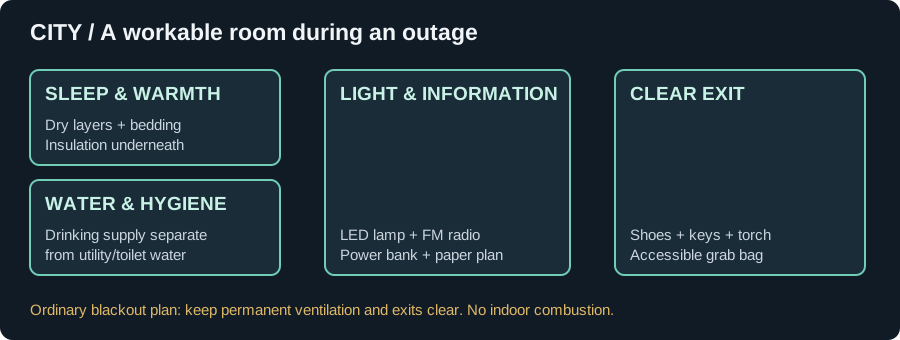
Make one usable living area
- Choose a dry room that suits the season and keeps escape routes available. In cold weather wear dry layers and insulate bedding from a cold floor with sleeping mats. Close unused rooms where safe; do not block permanent ventilation for an ordinary blackout.
- Use a head torch for moving and a low-power lantern for shared light. Keep a separate torch at the exit and batteries where everyone can find them.
- In a high-rise, plan for lifts, pumps, electronic entry and heating to fail. Confirm the building’s fire plan with management; keep keys and a light accessible. Store heavy water at a location the floor can support.
- Keep drinking water, food preparation and toilet/waste areas separate. Use bowls for small washing tasks rather than running water.
- Reduce energy use to the essentials. A phone, radio and LED light are more realistic small-battery loads than an electric heater or kettle.
- Set a relocation trigger: unsafe temperatures, unavailable essential treatment, sewage backup, structural danger or an evacuation instruction. Agree an accessible destination and route before it is needed.
Appliances that work without mains electricity
Manual can opener, food-safe jerry cans, insulated flask, manual torch/radio backup, sleeping mat, gravity-fed water dispenser and portable toilet. Rechargeable devices still need a charging plan. A camping stove is an outdoor cooking option only where its instructions and local rules allow it.
CO prevention: never run a generator, barbecue or outdoor-only stove in a flat, garage, tent, doorway or enclosed balcony. CDC advises generators outside at least 20 feet (about 6 metres) from doors, windows and vents. Where that separation is impossible, use batteries or a safer location. CDC generator guidance.
03 / Forest: shelter, navigation and rescue
This chapter covers being stranded outdoors, not establishing an indefinite wilderness settlement. A tent or tarp cannot provide the radiation shielding of a substantial building and is not a chemical shelter.
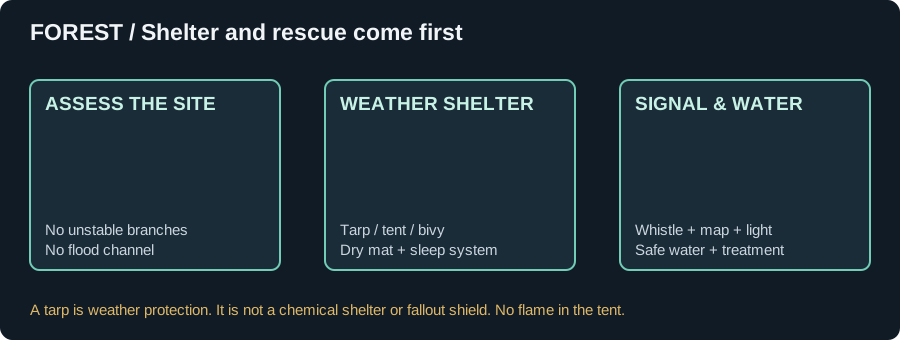
- Before travel, leave the route, expected return and overdue action with a trusted person. Carry an offline map and compass you know how to use; inspect weather and local hazards.
- If lost, stop and assess. If the location is safe, stay put and communicate your location; wandering makes rescue harder. Move only as necessary to escape an immediate hazard. Use a whistle or visible signal, and conserve phone power.
- Choose shelter away from unstable trees, falling branches, flood channels and exposed ridges. Keep an accessible exit. Use a tent, tarp or bivy as appropriate to weather and your skill.
- Put insulation beneath the body, then dry bedding and weather protection above. Keep a dry clothing set protected in a bag. Do not burn fuel inside a tent or bivy.
- Carry water and a treatment method matched to the source. Do not assume a clear stream is safe. A common microfilter may not remove viruses, chemicals or radioactive contamination; read its actual performance limits.
- Use carried no-cook food first. Avoid unknown plants, fungi and unverified edible-plant advice. Do not make foraging or hunting the food plan for the first three days.
Equipment systems: navigation, sun protection, extra clothing, light, first aid, lawful fire provision, repair tools, extra food, water/treatment and emergency shelter. Add prescription needs, a whistle and a communication plan. Fire bans and conservation rules still apply. NPS Ten Essentials and Outdoor Emergency Plan.
No-mains options: manual filter plus suitable disinfection where needed, hand tools, insulated flask, compass, whistle and a small USB charging setup. Solar under dense tree cover is unreliable; carry enough stored energy for your planned trip and contingency.
04 / Village: keep a small household functioning
Priorities: the water source and pump, heating fuel, roads, medicines, sanitation, livestock/pets and mutual help. Rural space helps with storage, but distance from services can increase the reserve needed.
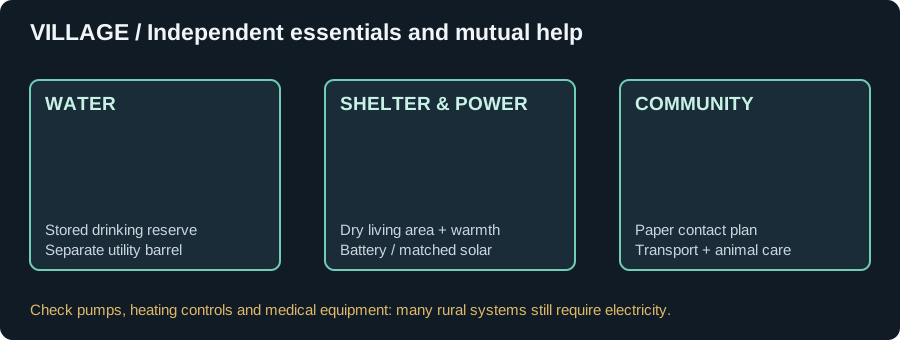
- Map how water reaches the house. A well can become unusable when its pump loses power; a generator must meet starting demand and be safely connected. Keep stored water independently of that pump.
- Check the existing heating system: many boilers and pellet stoves need electricity for controls or pumps. Maintain flues and alarms; use wood burners only if properly installed and serviced.
- Agree a neighbour contact and meeting point, transport for people who need help, shared tools and someone to check isolated households. Put contacts on paper.
- Inspect roof drainage, doors, animal enclosures and the route out before severe weather. Keep work gloves and sturdy footwear; do not enter unstable structures or floodwater to recover possessions.
- Keep animal feed/water and veterinary records. Include livestock watering and powered fencing needs in the plan; human drinking reserves are not an animal-water plan.
- Separate potable storage from roof water. A garden plot supplements later supplies; it does not replace food needed this week.
No-mains options: hand tools, wheelbarrow, gravity dispenser, rainwater tank for permitted utility uses, insulated cool box, manual can opener and a suitable existing solid-fuel stove. Hand pumps and fixed solar/battery systems need site-specific design, safe water arrangements and appropriate installation.
05 / Buy and plan for 3, 7 and 14 days
Use your own country’s target where it is longer. The water figures below are a drinking-only planning example based on 3 litres/person/day, not a universal ration or full household allowance. Add cooking, hygiene, heat, illness, infant feeding and animal needs.
| Per person | 3 days | 7 days | 14 days |
|---|---|---|---|
| Example drinking water | 9 litres | 21 litres | 42 litres |
| Food | 3 daily menus | 7 daily menus | 14 daily menus |
| Energy example at 40 Wh/day | 120 Wh usable | 280 Wh usable | 560 Wh usable |
Food and electricity needs vary. Write a menu and an appliance-use sheet for the actual household, then multiply and include a contingency. Use water containers you can safely lift; one large drum is hard to carry during evacuation.
Three-day foundation checklist
- Sealed safe water; labelled food-safe containers; three days of familiar no-cook or low-fuel meals; opener, utensils and special dietary supplies.
- Regular medicines and prescriptions, first aid, glasses/hearing supplies, menstrual products, infant feeding/nappies and pet needs.
- Head torch, shared LED lantern, radio receiving local broadcasts, spare compatible batteries, charged phone/power bank and cables.
- Warm layers, waterproof layer, bedding, sleeping mats, soap, toilet supplies, waste bags, clean towels and spare clothes.
- Cash, keys, protected document copies, paper maps/contacts, household plan, smoke and CO alarms where appropriate.
Extend beyond three days
Increase consumables to the chosen period, rather than buying more gadgets first. Add utility-water storage, replacement filter cartridges, safe toilet/waste capacity, a repair kit and enough charging capacity for the energy budget. Maintain a rotating food reserve. Have a plan for prescription continuity, refrigeration-dependent medicines and powered medical devices with the provider.
Compare the official country instructions; their quantities and scopes differ. Open the marketplace equipment lists.
06 / Small solar power: what a full set needs
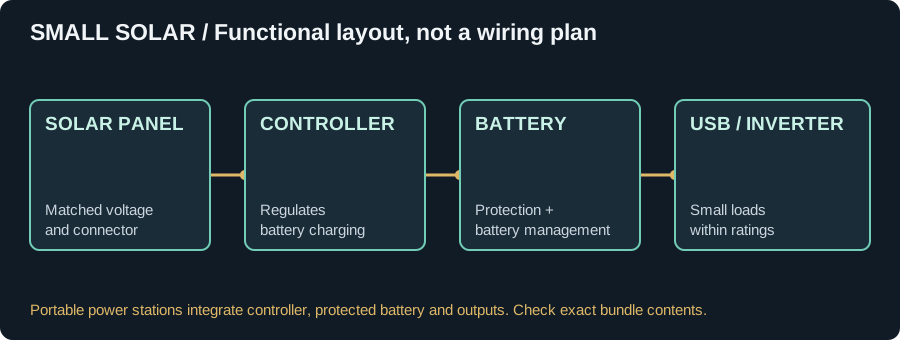
A portable solar generator usually means a battery power station charged by a panel. For a ready-made set, verify that the selected bundle includes the panel, charge cable, built-in charge controller, battery management, USB/DC outputs and an AC inverter if AC loads are required. Some DC-only products have no AC socket.
Size it from the loads
| Illustrative load | Daily use assumption | Energy |
|---|---|---|
| LED lamp | 3 W × 4 hours | 12 Wh |
| Radio | 2 W × 4 hours | 8 Wh |
| Phone charging | One assumed charge allowance | 20 Wh |
| Total | Example, before losses | 40 Wh/day |
Measure your real devices. If 80% of nameplate energy were usable, a 300 Wh battery would give about 240 Wh, or six days at that example load without charging. This is an illustration; inverter idle draw, temperature, battery condition and conversion losses change it. A 1,000 W heater would use that 240 Wh in about 14 minutes. Watts are output rate; watt-hours are stored energy.
Solar example: a 100 W panel × 2 equivalent full-sun hours × an assumed 0.7 overall factor = 140 Wh/day. With only 0.5 equivalent hours, the example is 35 Wh/day. These are scenarios, not local weather forecasts. Shade, winter, orientation and glass can reduce output substantially. Keep energy reserves for sunless days.
Verify the complete system
- Read the exact battery/station model and regional mains voltage. Check continuous and surge ratings against the load, including motor starting.
- Match panel open-circuit voltage, operating voltage, current, polarity and connector to the station’s input limits. Follow manufacturer instructions for cold-weather voltage and any parallel/series connection.
- Confirm the solar cable and required adapters are included. Use the manufacturer’s matched bundle when practical; a similar-looking connector does not establish compatibility.
- Keep the station dry, within its charge/discharge temperature range and with clear ventilation. Do not charge a damaged or swollen battery.
- Plug appliances into the station as instructed. Never backfeed a wall socket. Fixed wiring, separate controllers/batteries, fuse sizing and building connections require competent design and installation.
Researched examples: EcoFlow RIVER 3 Plus is a small integrated battery/inverter example; the manufacturer’s 110 W panel compatibility table includes it. DELTA 3 Classic is a larger 1,024 Wh example with a 220 W-panel bundle option. Check the exact package, UK sockets and cables at checkout; neither is represented here as a guaranteed multi-day household supply. RIVER specifications, panel manual, DELTA specifications.
For longer-term fixed systems, a normal grid-tied solar installation may shut down during an outage. Ask specifically about islanding/backup capability and designated backed-up circuits. Australian government solar design guidance.
07 / Water barrels, toilets and washing
Keep two clearly marked systems: DRINKING and UTILITY — NOT FOR DRINKING. Use containers explicitly suitable for drinking water for potable supplies; never reuse a chemical drum. Keep lids secure, containers shaded and dispensing equipment clean.
- Portable drinking supply: several manageable food-safe containers with caps/taps; label fill/check dates and follow cleaning instructions.
- Utility barrel: a covered water butt or tank with a stable base, secure child-resistant access, tap and overflow arrangement. A 100-litre fill adds roughly 100 kg before the tank’s own weight; do not put large tanks on balconies or raised floors without confirming load capacity.
- Toilet reserve: a dedicated bucket or jug can transfer non-potable water for flushing only while the drain/sewer system remains operational and local authorities permit it. Do not flush into a backed-up or damaged sewer. Avoid spills/aerosols and keep utensils out of food areas.
- Dry contingency: a proper portable toilet, compatible liners/absorbent material, toilet paper, handwashing supplies and a lidded waste arrangement. Follow municipal collection/disposal instructions; do not bury waste or empty chemicals wherever convenient.
- Rainwater: roof runoff may contain microbes and chemicals. Use only for permitted non-drinking purposes unless professionally assessed and treated. After fallout or a chemical release, do not collect or use exposed water until authorities confirm it is safe.
For microbial risk, boiling clear water for one minute (three minutes above about 1,980 m) is a CDC option; cool it covered. Boiling/disinfection cannot make fuel-, chemical- or radioactive-contaminated water safe. A filter is not a universal solution. CDC safe-water guidance and EPA disinfection guidance.
08 / Food storage, preservation and growing
Start with food you already eat: ready-to-eat tins, beans, nut butter, crackers, shelf-stable milk, fruit and appropriate special foods. Make a menu that accounts for fuel, water and waste. Keep supplies cool, dry, pest-resistant and above flood risk. Put new purchases behind older ones and check dates regularly.
Keep refrigerator/freezer doors closed and record outage time. A closed fridge generally gives about four hours; a full freezer about 48 hours, or 24 if half-full. These estimates depend on conditions. Use a thermometer and the official food-specific discard table; never taste food to judge safety. FoodSafety.gov outage chart.
- Choose commercially shelf-stable foods first. Drying, fermentation and home canning each need validated methods and storage conditions.
- For home canning, use tested recipes and the correct pressure process for low-acid food. Improvised boiling-water canning of meat or vegetables can cause botulism. National Center for Home Food Preservation.
- For a garden, assess sunlight, safe soil, clean water, climate, tools and time to harvest. Begin before an emergency with a small trial; use locally suitable varieties and succession planting.
- Quick leaves and herbs add variety; potatoes, beans and other staples need space, water, time and suitable conditions. Do not count unharvested crops as emergency calories.
- After chemical deposition or fallout, stop eating exposed garden produce until food authorities provide location-specific guidance. Washing alone does not establish safety.
09 / Chemical release or chemical warfare
The useful civilian plan is warning, distance, appropriate shelter or evacuation, decontamination and medical help. The chemical, release location and wind affect the correct action; a shopping kit cannot make an unknown toxic area safe.
- Follow police/fire/public-health instructions about leaving or sheltering. If a release is inside and you are exposed, move to fresh air away from the source. Outdoors, move away and upwind where possible without entering the plume.
- If told to shelter, close doors/windows and turn off systems bringing outside air in. CDC’s general chemical shelter guidance favours an interior room high in the building with few windows, large enough for the household and water if possible. Local incident instructions override this general choice.
- Keep radio, phone power, medicines, water, towels, tape and pre-cut plastic sheets ready. Seal instructed openings as directed; do not burn fuel in the sealed space. Wait for the official all-clear and ventilation instructions.
- If contaminated, get the chemical off promptly: blot rather than rub, remove contaminated clothing, double-bag it, and wash with lukewarm water and mild soap without scrubbing. For burning/affected eyes, CDC advises flushing 10–15 minutes. Keep contaminated items away from people and await disposal instructions; do not put them in ordinary rubbish.
- Seek urgent medical guidance for exposure, symptoms or difficulty decontaminating. If a chemical was swallowed, do not induce vomiting or drink anything further unless medical professionals instruct it. Do not attempt household chemical neutralisation on skin.
CDC response (22 July 2026), chemical sheltering (17 June 2026), decontamination (22 July 2026). Use local emergency contacts rather than assuming US telephone numbers apply worldwide.
10 / Nuclear detonation and radioactive fallout
Get inside, stay inside and stay informed. Seek a substantial building promptly, then the basement or central interior away from external walls, windows and roof. Bring pets. A vehicle or tent gives much less protection than a substantial building. Do not travel across an affected area to collect relatives already sheltering at school or another facility.
Plan to remain sheltered for at least 24 hours and follow official instructions; 24 hours is not an automatic all-clear. Leave if the building becomes immediately dangerous, such as fire or collapse, using the safest available alternative. Food, water, sanitation, medicines and radio access help make sheltering possible. CDC preparedness guidance (31 January 2025).
- If you were outside, carefully remove outer clothing without shaking dust around, bag it and keep it away from people/pets.
- Gently shower with soap and shampoo, not conditioner; do not scrub or damage skin. If washing is unavailable, carefully wipe exposed skin. Put on clean clothes. Follow the linked detailed instructions for wounds and assistance.
- Use sealed food and a confirmed safe water supply. Avoid exposed rainwater, produce and dust until officials assess contamination.
- Monitor official broadcasts for shelter, evacuation routes and contamination-screening locations; conserve phone lines for urgent needs.
CDC self-decontamination instructions. A particulate respirator can reduce inhalation of some particles when correctly used; it does not shield the body from penetrating radiation. A home radiation meter needs suitable range, calibration and informed interpretation; a low reading is not permission to leave official shelter.
Potassium iodide: only take it when public-health officials or a clinician instruct you. It has a narrow role protecting the thyroid from radioactive iodine; it is not a general radiation antidote and CDC warns it will not protect against nuclear-bomb fallout. Never substitute table salt or iodine supplements. CDC KI guidance (30 January 2025).
11 / Filtering masks, breathing air and oxygen cylinders
| Equipment | Useful role | Critical limit |
|---|---|---|
| FFP2/FFP3 or N95 particulate respirator | Specified airborne particles, with correct selection and fit | Does not supply oxygen or filter every gas/vapour; does not block penetrating radiation |
| Reusable mask + matched filter | Only hazards, concentrations and conditions covered by the approved complete system | Gas/particle cartridges are not interchangeable; seal, service life and facial hair matter |
| CBRN escape respirator | Specified escape conditions for a certified device | Limited environment/time; training, fit and storage requirements; not permission to enter danger |
| SCBA: cylinder + regulator + full-face mask | Independent breathing-quality air in a professionally selected complete system | Finite air, heavy equipment, training, inspection, approved refilling and rescue planning |
| Medical oxygen cylinder/concentrator | Prescribed oxygen therapy | Not a general anti-gas system; oxygen supports fire; a concentrator requires power |
Air is not the same as oxygen. Professional open-circuit breathing apparatus commonly uses breathing-quality compressed air with a compatible pressure regulator, demand valve and mask. Do not connect a random cylinder to a mask or refill it with a tyre compressor. Do not enter smoke, a sewer, tank, confined space or an unknown chemical plume using shopping-site equipment.
For particulate masks, verify the actual certification and fit instructions. For chemicals, identify the hazard and have competent selection of the complete system, including cartridge class, expiry/service life, skin/eye protection and training. Filtering masks do not make oxygen-deficient air safe. Avoid surplus or unknown-origin masks and filters sold with sweeping “nuclear protection” claims.
UK HSE: respirators versus breathing apparatus; NIOSH CBRN approval and limitations (28 October 2026); NHS home oxygen. If already prescribed oxygen, arrange outage and cylinder-backup planning with the clinical supplier; do not adjust treatment yourself.
Professional reference: Dräger PSS 4000 SCBA illustrates the complete breathing-air equipment category. Consult the manufacturer/authorised specialist about the full configuration, suitability, training, servicing and cylinder supply. This is an untagged reference, not a claim that it is a household CBRN kit.
12 / Equipment to compare before buying
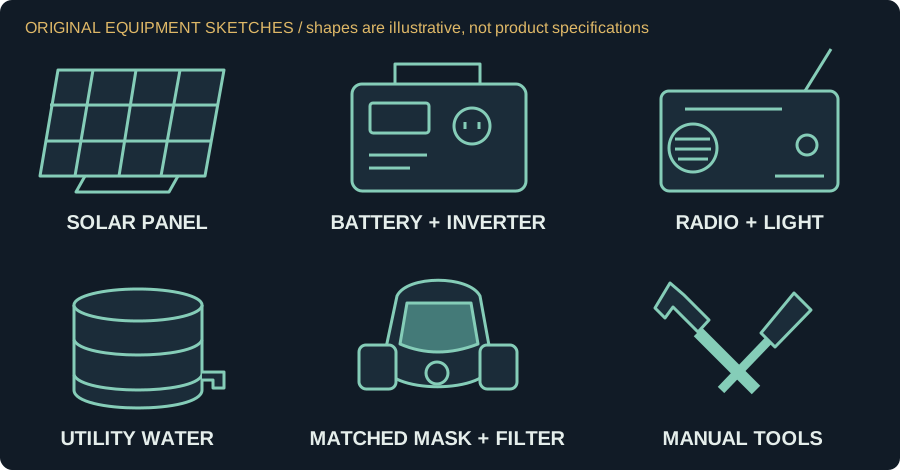
Begin with the three-day essentials, then buy equipment that resolves a specific gap. Each category below has an Amazon UK comparison search. Search results, third-party sellers, certifications, included parts, price and stock need checking at the retailer. A search link does not validate every result. We have not independently tested these products.
UK shopping links on the live website use our affiliate ID and are labelled paid links. As an Amazon Associate I earn from qualifying purchases. The downloadable manual links to this live page rather than embedding affiliate shopping links.
Portable matched solar set
Small integrated battery/controller/inverter example. Verify the selected package includes panel and charging cable.
Compare on Amazon UK (paid link) ↗Larger matched solar set
Larger battery option. Check continuous/surge demand and exact UK bundle contents.
Compare on Amazon UK (paid link) ↗Panel for an existing station
Match input voltage/current, connector and polarity to the exact station; do not connect an unmatched panel.
Compare on Amazon UK (paid link) ↗Radio, torch and charging combination
Check local broadcast reception and realistic charging specifications. Keep independent light and phone power.
Compare on Amazon UK (paid link) ↗Independent USB power bank
Check usable Wh, output standard, safety documentation and charging temperature limits.
Compare on Amazon UK (paid link) ↗Head torch and LED lantern
Choose useful low-power modes; carry independent spare lighting.
Compare on Amazon UK (paid link) ↗Drinking-water containers
Use explicitly potable-water-rated material and manageable sizes; check cleaning instructions.
Compare on Amazon UK (paid link) ↗Utility-water barrel
For suitable non-drinking uses. Confirm a stable load-bearing location, secure lid, overflow and installation.
Compare on Amazon UK (paid link) ↗Larger utility-water storage
Water weighs about one kilogram per litre. Keep utility water clearly labelled and separate.
Compare on Amazon UK (paid link) ↗Transfer and hygiene tools
Dedicate equipment to either drinking or utility/toilet use; never share utensils between them.
Compare on Amazon UK (paid link) ↗Portable toilet
Match liners/chemicals to the unit and follow local waste-disposal instructions.
Compare on Amazon UK (paid link) ↗Shelter and sleeping insulation
Choose weather ratings and a shelter you can pitch; this is not a chemical/fallout shelter.
Compare on Amazon UK (paid link) ↗Water treatment
Verify organism/contaminant limits; ordinary treatment cannot make chemical/fallout water safe.
Compare on Amazon UK (paid link) ↗First aid and repair tools
Adapt to your skills, medication and household needs.
Compare on Amazon UK (paid link) ↗Particulate respirator comparison
Particles only, within certification and fit limits. Not general gas protection or oxygen supply.
Compare on Amazon UK (paid link) ↗Reusable respiratory protection comparison
Professional hazard-specific selection is required. A shopping search does not establish CBRN protection.
Compare on Amazon UK (paid link) ↗Shelter-sealing supplies
For use on official chemical sheltering instructions; not a permanent airtight occupied room.
Compare on Amazon UK (paid link) ↗Decontamination support supplies
Basic support supplies do not make the wearer safe to enter a contaminated area.
Compare on Amazon UK (paid link) ↗Smoke and carbon monoxide alarms
Choose appropriate compliant alarms and install/test according to instructions.
Compare on Amazon UK (paid link) ↗Specialist breathing-air cylinders, regulators and CBRN escape systems require verified complete-system approval, selection and training. See the manufacturer and HSE links above. Medical oxygen is a prescribed treatment, not a general survival-kit purchase.
Tools: opener, adjustable wrench, screwdrivers, pliers, work gloves, repair tape, scissors, cable ties, whistle and a basic household first-aid kit. Keep tools within your skill; gas work, electrical installations, structural changes and cylinder systems need appropriate professionals.
Radio choice: verify reception of your local emergency broadcaster, battery type, charging input and antenna. A tiny built-in solar cell or hand crank is a backup, not a promise of repeated phone charging. Keep a separate power bank and an independent torch so one failure does not remove every function.
13 / Practise and maintain the plan
- Run a short safe no-mains exercise: find equipment in the dark, tune the radio, prepare one no-cook meal and test phone charging.
- Measure daily device energy use and record battery runtime. Practise putting up a tent/tarp in safe conditions and using a map before travelling.
- Review food, water, medicines, battery condition, filters and equipment instructions on a calendar; review again when health, household or location changes.
- Keep a printed plan: people/pets, contacts, local alert sources/frequencies, safe destinations, accessibility needs, transport and essential treatment.
- Share practical tasks with neighbours. Build reserves gradually and preserve money for ordinary needs. Tools and stored goods work best alongside skills and reliable information.
14 / Research and official country advice
Consult the alphabetical country directory and interactive map for each researched country’s official links, quantities, source dates and context. The directory currently has 31 researched profiles and 218 marked awaiting research; it does not establish that every country has issued a 72-hour warning. Regional examples, including Queensland and Cape Town, are explicitly labelled.
Core country sources include the UK Cabinet Office, Germany’s BBK, France’s ministry, Danish Emergency Management Agency, Norway’s DSB, Swedish Krisinformation, Government of Canada, New Zealand NEMA and Get Ready Queensland.
Health and hazard actions link directly to CDC, NHS, HSE and NIOSH. Outdoor techniques link to the US National Park Service. Product specifications link to the manufacturer. All were checked for this edition on 10 November 2026; a page’s update date may reflect minor edits, not a new threat. Local incident instructions override a general planning article.
Diagrams are original schematic illustrations, not wiring diagrams, structural plans or certified shelter designs. The text is our own synthesis; complete licensed government articles appear separately on the relevant country profiles with attribution and licence links.